

• 1.jpg
  • 2.jpg
  • 3.jpg
  • 4.jpg
  • 5.jpg
  • 6.jpg
  • 7.jpg
  • 8.jpg
Master the phases of commercial ropes course construction, from feasibility studies to installation. Boost your aerial adventure park revenues right here.
◆ Commercial Ropes Courses · Adventure Business

High-ROI Commercial Ropes Course Construction

Navigating the complexities of commercial ropes course construction requires a strategic balance between thrilling guest experiences and strict operational efficiency. As an adventure park operator, your primary goal is to build a high-yield attraction that maximizes safety, throughput, and long-term profitability. This guide breaks down the critical phases of developing a highly lucrative aerial adventure asset.

TL;DR Summary

Key takeaways for operators

  • Modern continuous belay systems drastically reduce staffing overhead and human error risks.
  • Multi-level vertical structural designs improve footprint ratios and revenue per square meter.
  • In-depth feasibility studies and load testing are mandatory to prevent massive budget overruns.
  • Indoor facilities guarantee year-round returns, while outdoor parks command premium authentic experience ticket pricing.
  • Strict adherence to EN 15567 and ACCT standards is non-negotiable for liability insurance.
Park Infrastructure

The anatomy of a modern aerial adventure park

Modern climbing parks are engineered to deliver high-capacity entertainment with minimal staffing requirements.
Integrating a continuous belay system

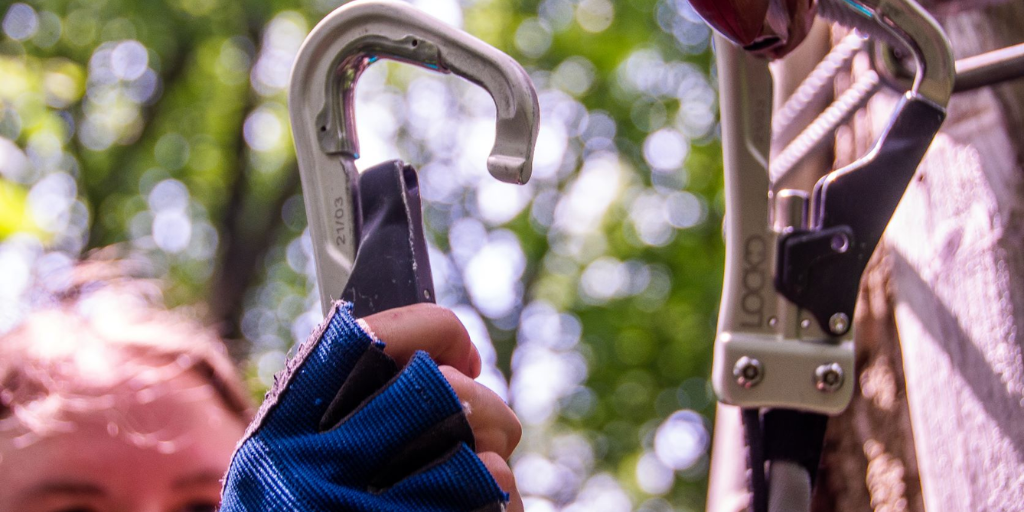
A well-designed facility relies on a continuous belay system to drastically reduce the risk of human error during operation. This closed-loop technology ensures guests remain securely attached from start to finish. Upgrading to these modern lifelines directly lowers your staffing overhead and limits your insurance liabilities.

Optimizing the footprint ratio

Maximizing your available space means designing multi-level structures that improve your overall footprint ratio. Vertical layering allows you to stack physical challenges, multiplying your hourly participant capacity without expanding land use. This structural density is the secret to generating significantly higher revenue per square meter.

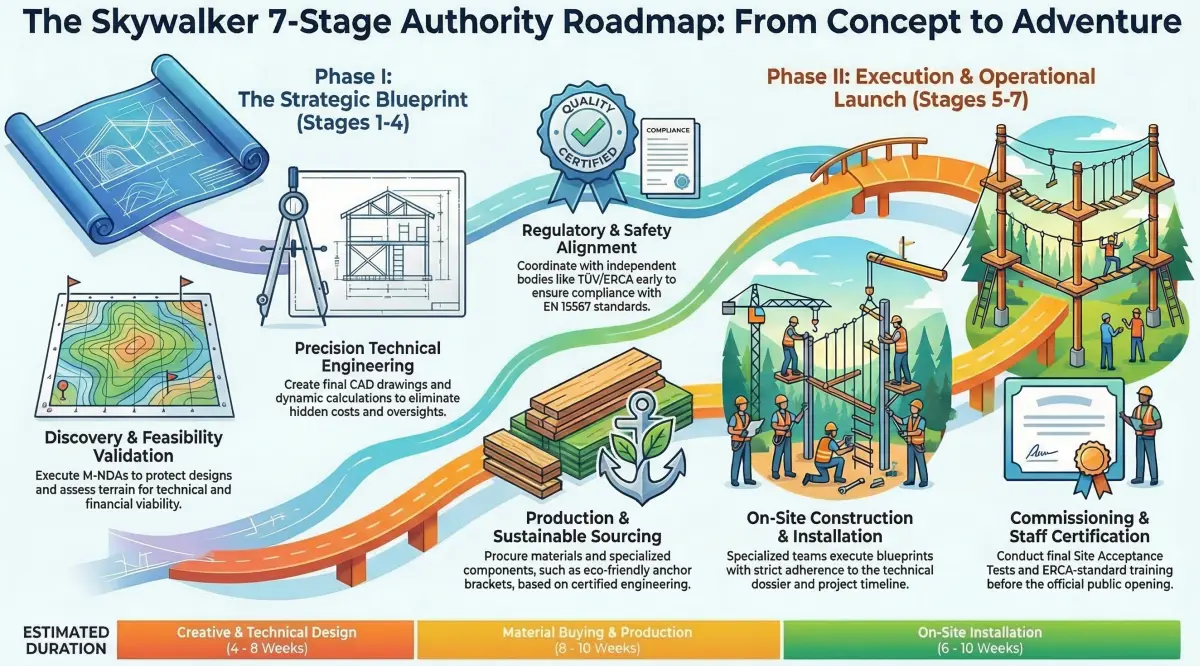
Planning a new build? Our ultimate guide on commercial ropes course construction outlines the 7-stage roadmap.

The Skywalker 7-Stage Adventure Project Roadmap.

Project Pipeline

Key phases of design, installation, and ROI planning

Turning a raw concept into a profitable reality requires a phased approach to high ropes course installation.

Feasibility studies and spatial planning

Every successful build starts with in-depth feasibility studies and spatial planning to evaluate site topography and target demographics. Engineers assess soil stability, tree health, and structural load points to determine the most cost-effective layout. Skipping this research often leads to massive budget overruns.

Engineering, load testing, and fabrication

Once the layout is approved, the project moves into structural engineering and rigorous dynamic load testing. Fabricators build platforms and cables designed to withstand extreme weather and heavy daily use. Certified inspectors must thoroughly validate the entire installation before opening.


Indoor vs outdoor ropes course ROI

Indoor environments Building an indoor facility guarantees year-round operations, shielding your revenue stream from unpredictable weather. The consistent daily foot traffic accelerates your return on investment, allowing for easier integration with family entertainment centers, arcades, and F&B.
Outdoor nature parks Outdoor parks offer an authentic experience that commands premium ticket prices. Utilizing existing healthy trees significantly reduces steel fabrication costs, though operators must budget for arboreal maintenance. Success relies on solid seasonal marketing during peak summer months.
Operational Efficiency

Understanding throughput and operator costs

Financial success hinges on effectively managing how quickly guests move through your aerial adventure park.

Calculating throughput capacity

Your maximum revenue is directly tied to your peak throughput capacity, dictating how many tickets you can sell per hour. Designing linear routes with strategic passing lanes prevents frustrating bottlenecks and keeps traffic flowing smoothly. Faster guest rotation translates to higher daily earnings and vastly improved customer satisfaction scores.

Reducing long-term operational expenses

Smart design reduces your recurring operator costs by minimizing the need for constant on-course rescue interventions. Implementing smart lifecycle management protocols cuts down on the sheer number of floor staff required, protecting your profit margins and ensuring a scalable business model.

EN 15567 and ACCT standards

Protecting your business means adhering strictly to international safety frameworks like EN 15567 and ACCT standards. These rigorous guidelines dictate everything from cable tension limits to the mandatory frequency of professional inspections. Maintaining documented compliance is non-negotiable for securing liability insurance, making rigorous training and education for your staff essential.

Mastering the intricacies of commercial ropes course construction is the foundation of a resilient and highly profitable adventure business. By prioritizing high-throughput layouts and adhering to strict frameworks, operators can deliver exceptional experiences while keeping overhead low.

Common Questions

Frequently asked questions

What is the average ROI for a ropes course?

A well-managed facility typically sees a full return on investment within two to three years of operation. This timeline relies heavily on maximizing your daily throughput capacity and maintaining exceptionally low staffing overhead. Smart commercial ropes course construction ensures the layout is optimized for high volume right from the start.

How much does commercial ropes course construction cost?

The total investment varies wildly based on the footprint ratio, obstacle complexity, and chosen safety belay technology. A basic setup might start at lower six figures, while massive multi-level towers easily command a premium price tag. Engaging in feasibility studies early prevents costly structural surprises during the final build phase.

What are the safety standards for high ropes courses?

Operators must comply with strict international regulations, primarily the EN 15567 and ACCT standards. These rulebooks dictate the required tensile strength of cables, proper construction materials, and mandatory annual inspection cycles. Failing to meet these strict safety standards will void your insurance and heavily endanger your guests.

How do you calculate throughput for an aerial park?

Throughput is calculated by measuring the exact time it takes an average guest to complete the longest obstacle sequence. You multiply this figure by your total harness inventory and operating hours to find your daily maximum capacity. Effective commercial ropes course construction eliminates tight corners to keep this physical movement entirely fluid.

What is a continuous belay system?

This is a closed-loop safety mechanism that prevents guests from ever unclipping from the safety line while at height. A specialized trolley glides smoothly over brackets and transitions without requiring any manual carabiner adjustments. This technology drastically lowers accident risks and significantly reduces the number of supervising staff required.

EN 15567 Compliant Fixed-Price Turnkey Proposals Expert Spatial Engineering

Ready to start your project?

Our consultancy team will assess your site, define a concept, and produce a fixed-price proposal — with the feasibility fee credited back to construction.

Related reading

Explore the adventure business

Turnkey planning Build Your Park

The full Skywalker process: from fixed-price feasibility study through design, engineering and opening day.

Service Consultancy — Feasibility & Concept

What a Skywalker feasibility study covers — and how the fee credits back into construction cost.

Service Design & Architecture

How Skywalker translates a site concept into engineered construction drawings and permit-ready specifications.

Service Concepting & Theming

Turning a site brief and investor vision into a coherent, themed guest experience with commercial logic.

Service HRM & Operations Planning

Staffing structures, hiring frameworks and operating model design for adventure parks at scale.

Product AirCruizer Cable Bicycle

An aerial cable bicycle that adds a low-intensity, family-accessible revenue stream to any adventure destination.

Product Net Adventure

Multi-level suspended net structures — high dwell time, low staffing cost, strong ROI for family parks.

Product Ultimate Adventure Tower

A vertical multi-discipline anchor attraction that drives park-wide footfall and upsell across adjacent attractions.

Service Zipline Design & Engineering

Engineered zipline specifications — why site-specific design protects your permit, insurance and long-term operating margin.

Products overview All Products — Attraction Range

Browse the full Skywalker product range to plan your park's attraction mix and revenue model.