• 6.png
  • 1.png
  • 4.png
  • 3.png
  • 5.png
  • 2.png
◆ Strategy & Planning · Master Planning

Master planning that secures ROI before the first construction drawing.

Other firms produce a layout. Skywalker produces a logistical design — the master plan as your ROI engine, locked into the site geometry before any construction drawing is committed.

Attraction mix, guest flow, throughput modelling, vendor selection, 3D walkthrough — built by the engineers who will also build the park. No handoff losses between planner and builder. No coordination gaps between designer and operator.

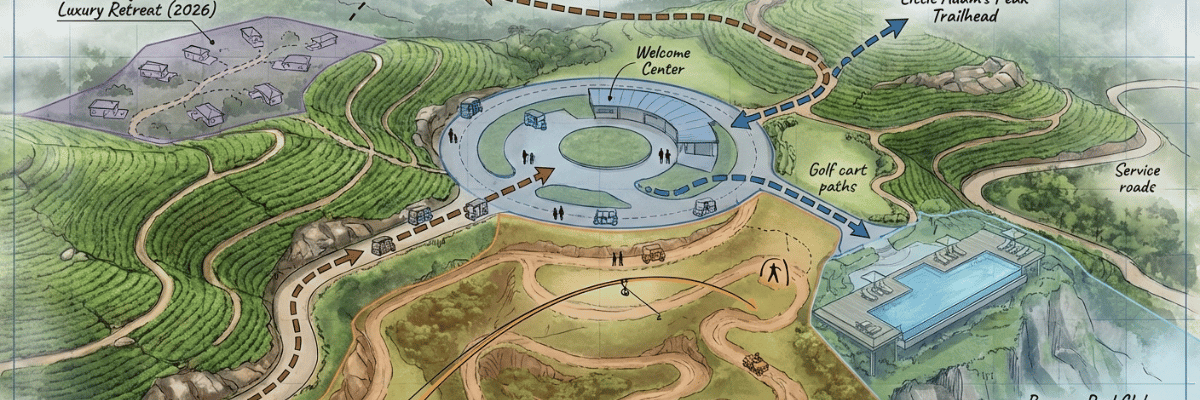
Skywalker master planning — logistical design, 3D modelling and throughput analysis for adventure parks
Profitability by design

Logistical design is the master plan

An adventure park's profitability is set during the design phase — not in operations, marketing, or pricing. Profitability is a function of throughput: the number of guests the park can safely and efficiently serve per operating day. Throughput is in turn a function of logistical design: how attractions, paths, queueing, amenities, and back-of-house operations sit together on the site.

This is why a master plan written by an architect — or a marketing-led concept agency — cannot deliver the throughput the financial model assumes. Architecture firms produce buildings that meet planning codes. Concept agencies produce themed narratives. Neither models the operational consequences of a layout. Skywalker does — because the team that draws the master plan is also the team that will install, certify, and lifecycle-manage the park.

👪

Guest experience

Poor logistics produce queues, confusing routes, and bottlenecks at popular attractions. Good logistics produce seamless flow, full sightlines onto the next attraction, and natural pacing — the conditions for high dwell time and organic referral.

Operational throughput

Throughput is what your financial model is sold on. A logistically designed park reaches close to its theoretical capacity day after day. An under-designed park forfeits a meaningful percentage of capacity every single operating hour — permanently — once the concrete is poured.

👤

Staffing efficiency

An under-designed park requires more staff — not to run more attractions, but to manage queues, complaints, and bottleneck recovery. A logistically efficient park needs fewer staff for the same revenue. Labour cost differentials compound year over year.

A park can have the most exciting attractions in the world. If the logistics are flawed, the business will struggle.Skywalker Master Planning — design philosophy
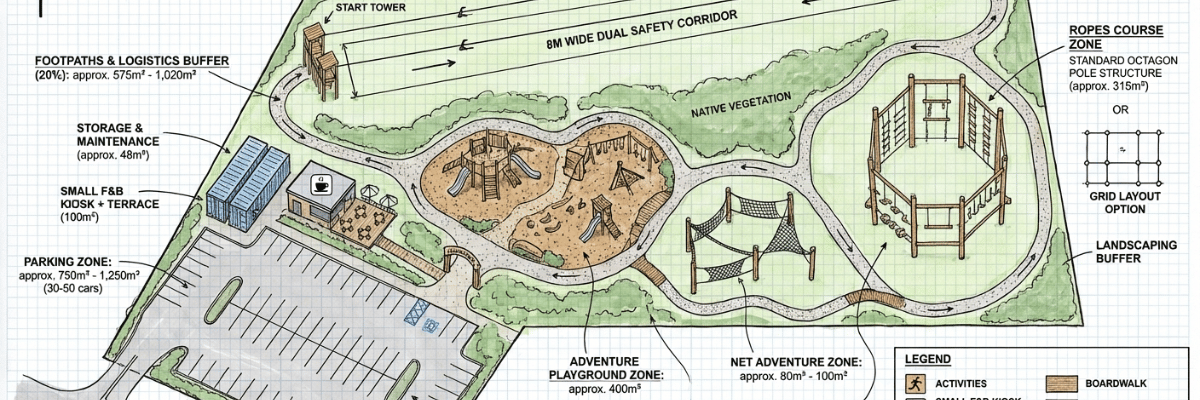
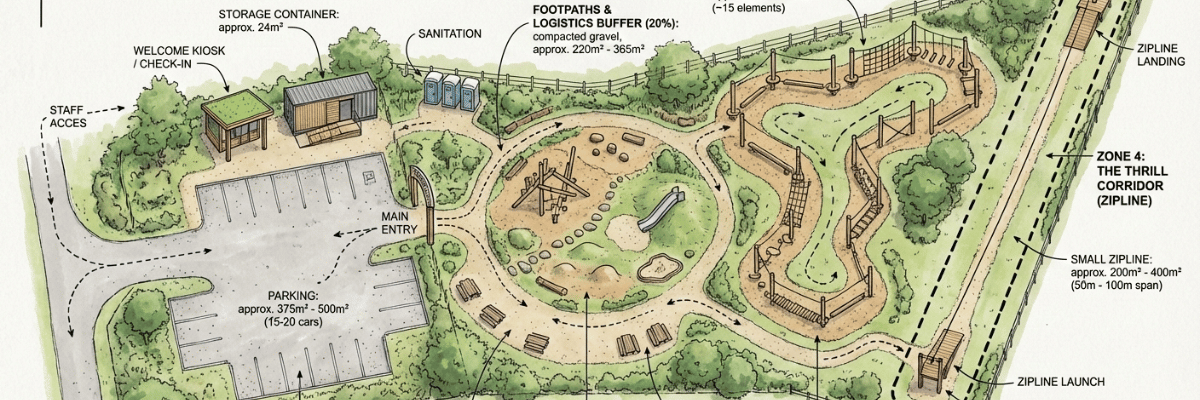
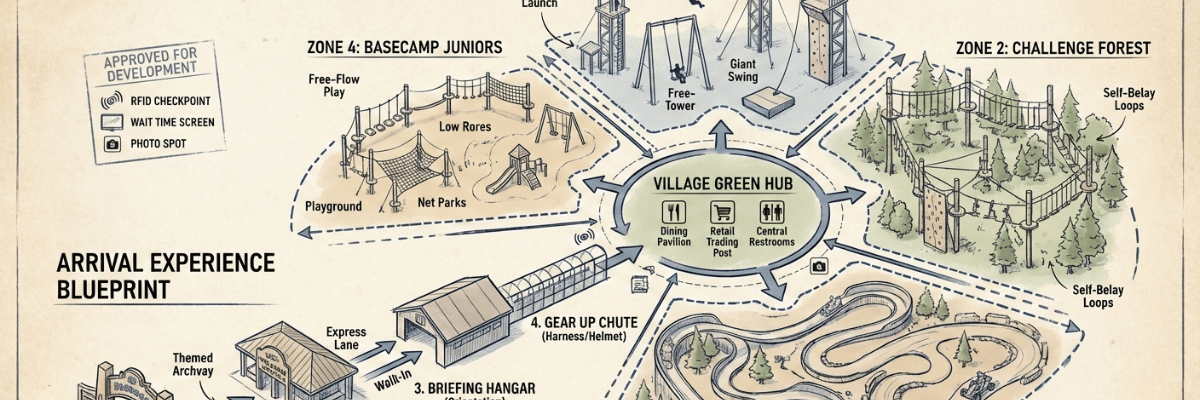
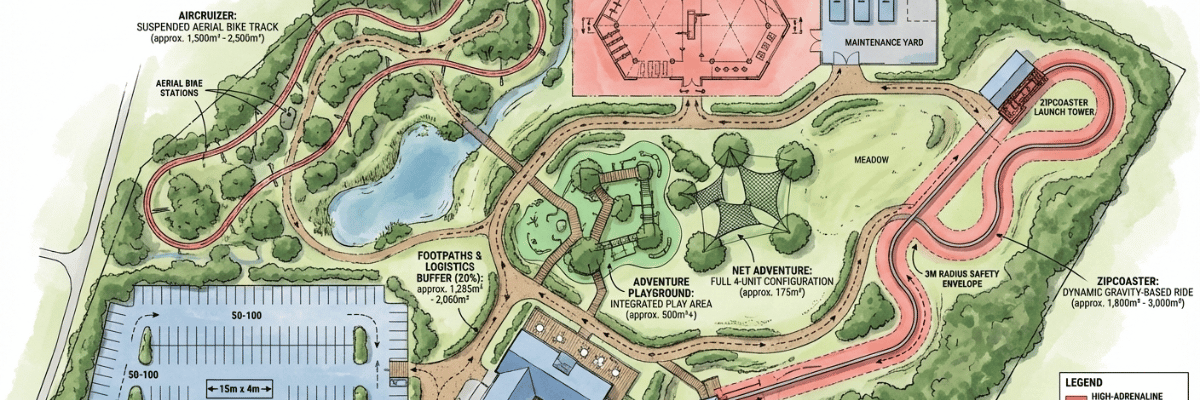
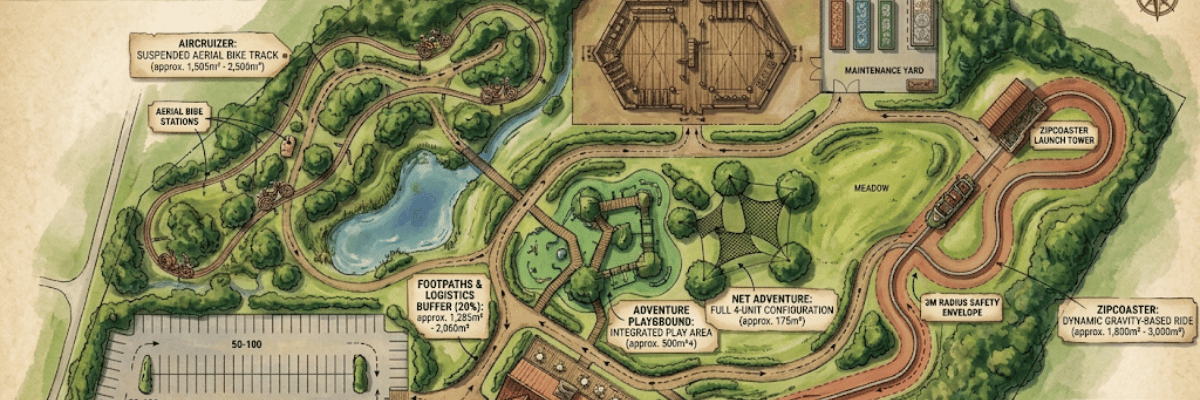
Skywalker adventure park master plan — site layout, attraction zones, guest flow routing and logistical design overview
What a Skywalker master plan contains

Six deliverables, all engineered for your specific site

Master planning is scoped as a fixed-price engagement. The deliverables below are produced sequentially over the engagement period — each one validated with you before the next begins. At completion, the package is robust enough to brief detailed engineering and construction tendering without renegotiation of scope.

📍

Spot Plan → Master Plan

A spot plan locates attractions on the site. A master plan integrates them into the site's operating system — paths, sightlines, service routes, queueing capacity, and emergency egress, all designed in concert. The evolution from one to the other is where logistical thinking enters the project.

🎯

Attraction mix & vendor selection

Independent technical analysis per attraction type — ziplines, ropes courses, ZipCoasters, Net Adventure zones, free-fall devices. Vendor selection matrix where specialised third-party components are required, evaluated on EN compliance, lead time, and integration cost into the wider site design.

🚶

Guest flow & throughput model

Hour-by-hour modelling of guest movement through the park, by attraction and by visitor profile. Identifies bottlenecks before construction begins, not after. Validates the attraction mix against your projected attendance curve so the financial model holds.

🎬

3D modelling & virtual walkthrough

Photorealistic 3D site model with virtual walkthrough. Investors, planning authorities, operations teams, and marketing partners see the same park before a single technical drawing is signed off. Disagreements surface here — not on site during installation.

🛡

Logistical routing & back-of-house

Staff stations, equipment storage, F&B service paths, waste routing, deliveries, and emergency vehicle access — designed alongside guest experience, not retrofitted afterwards. Operational efficiency is built into the geometry, not bolted on by staff workarounds later.

🌱

Expansion zones & phasing plan

Year-one opening is rarely the final form of a park. Master planning identifies the expansion zones and the engineering implications of phasing — so the year-three addition does not require demolishing the year-one footprint.

Why this determines your ROI

The two-parks problem

Imagine two parks with identical attractions, identical capital investment, and identical catchment area. One is laid out by a generalist architect who has never operated a leisure venue. One is laid out by a logistical design team that has built and operated dozens of adventure parks. The financial models look the same on paper. The futures do not.

The under-designed park

Theoretical capacity, real-world bottleneck

Low actual throughput despite high theoretical capacity. Popular attractions choke. Queueing infrastructure was an afterthought.

Inflated staffing to manage frustration, recover bottlenecks, and triage complaints at the front gate.

Diminished repeat-visit rate. Online reviews mention waiting more than they mention the attractions.

Operating costs run higher than the model predicts. Revenue capped lower than the model predicts. The spread compounds every operating season.

The logistically designed park

Throughput approaches theoretical capacity

Throughput operates close to theoretical capacity day after day. Attractions are paced and sequenced. Guests move; queues do not build.

Lean staffing — throughput is baked into the design, not enforced by labour. Staff focus on safety and hospitality, not crowd recovery.

High dwell time, strong repeat-visit rate, and organic referral momentum. F&B revenue lifts because guests linger.

Operating costs hold to the model. Revenue holds to the model. The financial case the project was sold on stays intact.

Where master planning sits in our services

Consultancy validates whether to build. Master Planning designs how it fits.

Upstream service

Consultancy

Answers: should we build this at all? Owns the commercial feasibility question — market sizing, business case, financial model, risk analysis, and the go / no-go decision. Outputs feed the master planning brief.

View consultancy →
You are here

Master Planning

Answers: given a go decision, what fits this site and how does it operate? Owns the spatial and operational feasibility question — site geometry, attraction mix, flow, throughput, vendor selection, 3D walkthrough. Outputs feed the engineering brief.

Works with

Where master planning connects to the rest of the team

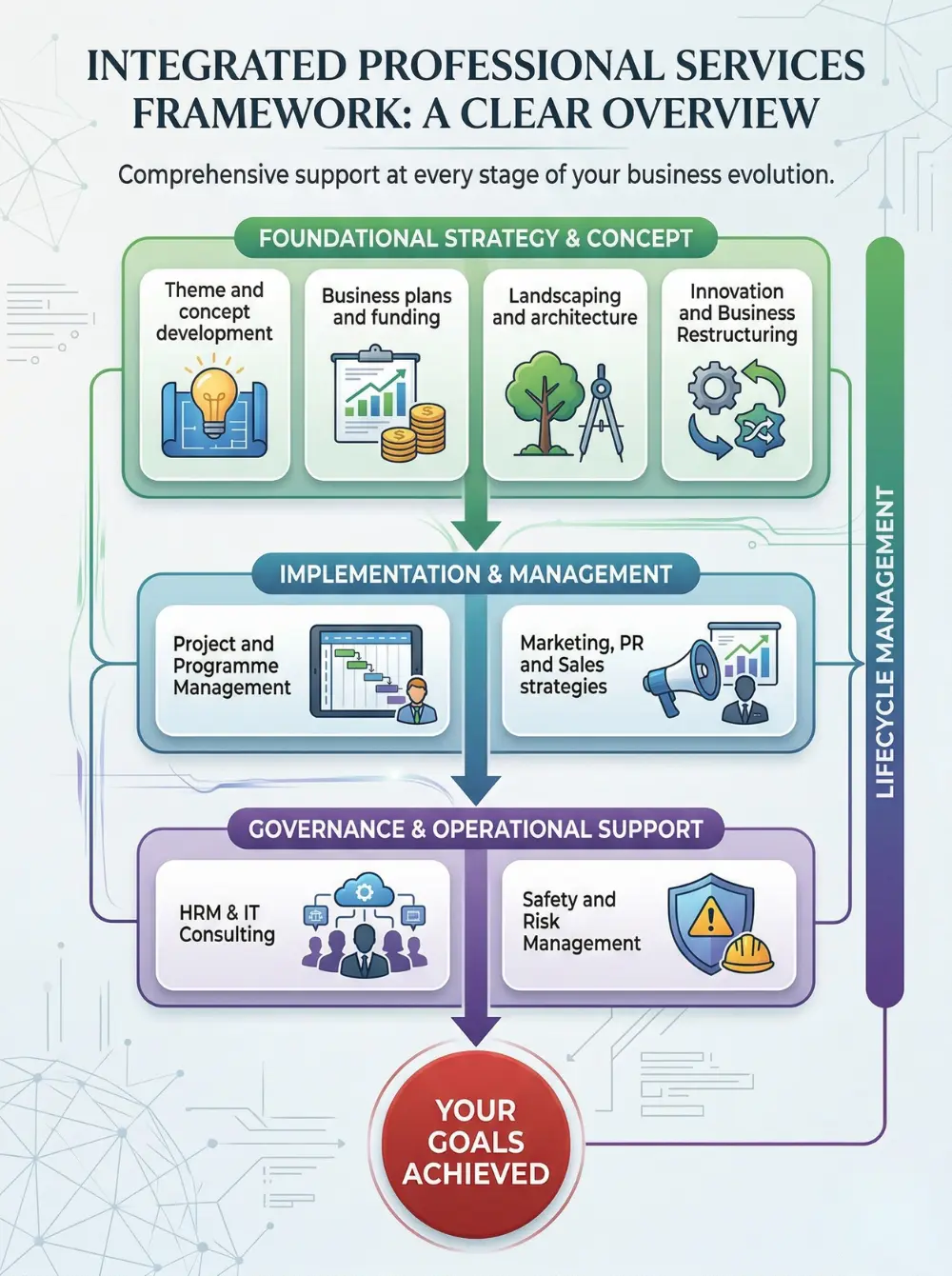
Master planning sits in the middle of the Skywalker discipline stack. Upstream from it, consultancy validates that there is a project worth planning. Downstream, design and architecture translate the master plan into construction documents. Across the lifecycle of the project, Build Your Park describes the timeline these disciplines occupy.

Founded 2005 — over 20 years in adventure park development Offices in Amsterdam, Dubai & Riyadh EN 15567-01 compliant design & inspection Projects across Europe, the Middle East & beyond

Ready to master plan your park?

Master planning is a fixed-price engagement — the deliverables are scoped before work begins, so you know exactly what arrives and when. Send us your site and the brief, and our team will respond with scope and timing for your engagement.