

What Design & Architecture covers
This phase begins the moment your concept has received sign-off and ends with a certified documentation package. Our design team conducts a structured site assessment, produces 3D layouts and technical drawings, performs structural and force calculations, and compiles the Construction Book required by your regulatory authority and certification body.
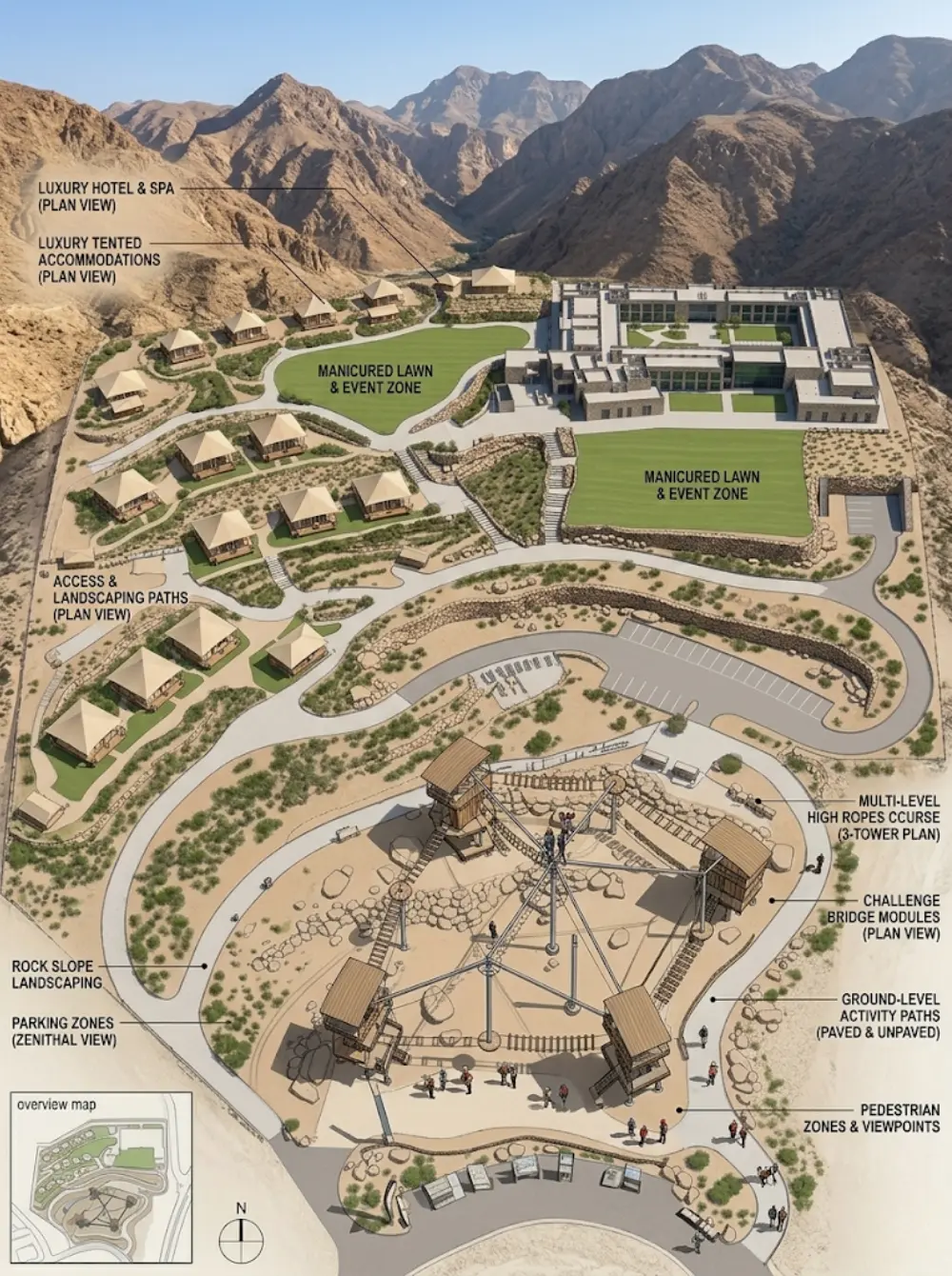
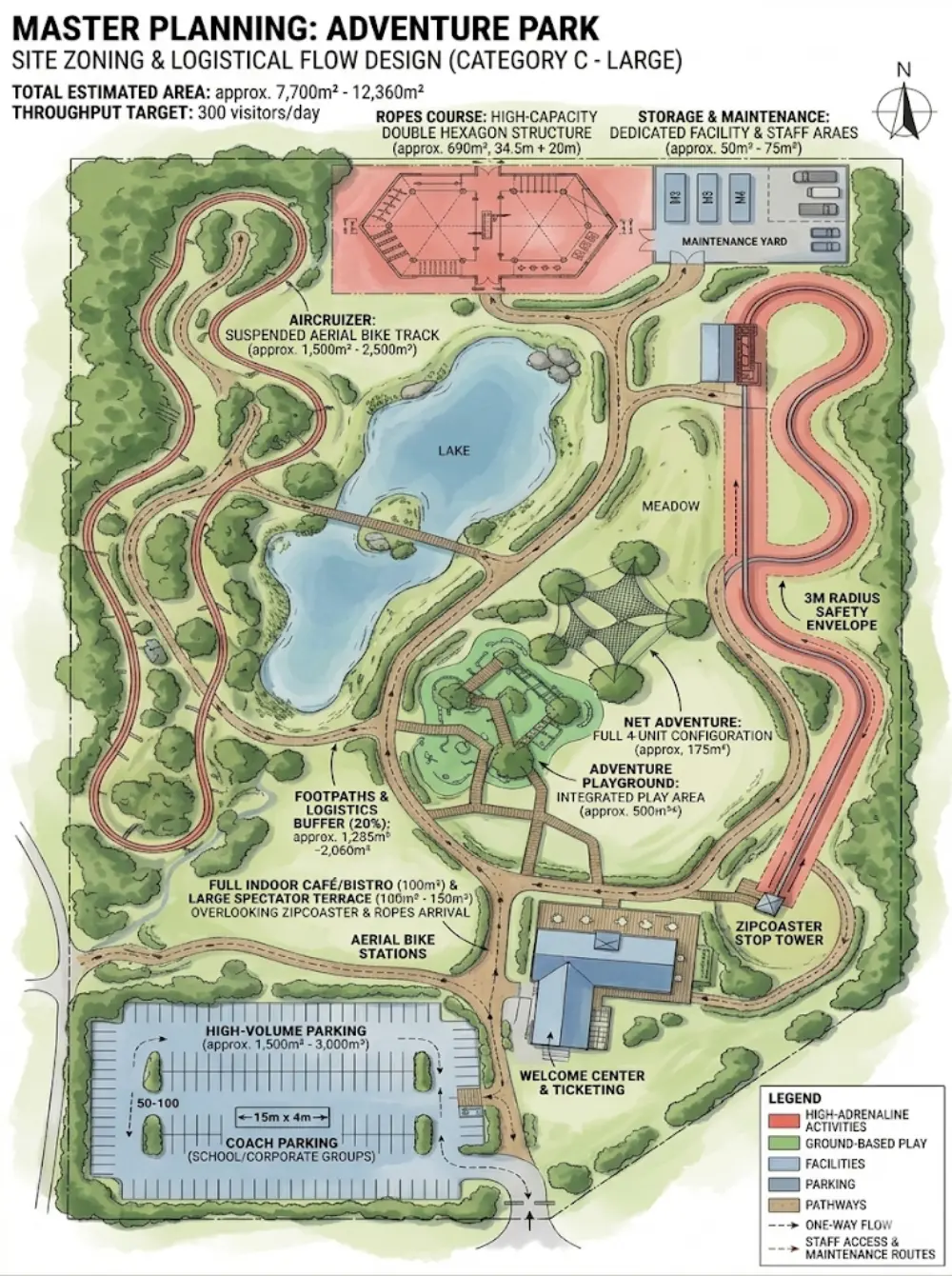
In the leisure and recreation sector, customer expectations have shifted considerably. Paying close attention to the location is essential if you want to maximise the profit potential of your outdoor facility — the natural environment surrounding an attraction is a commercial asset. Every layout we produce integrates the activity routes into the surrounding scenery: ponds, footpaths, undulating terrain, and indigenous vegetation give the park its distinctive character and broaden its appeal across all visitor demographics.
- Review of the topographic, geotechnical and ecology surveys you supply, with access constraint mapping
- 3D attraction layout, routing design, and visitor flow planning
- Structural engineering: load capacities, wind and weather stress, anchor stability
- Force distribution calculations compliant with EN 15567 (European Ropes Course Standard)
- Construction Book compilation for regulatory and insurance submission
- Early coordination with independent inspection bodies (TÜV or equivalent)
How this integrates with your project
From your site surveys to a certifiable design
Review of your site surveys
We review the topographic, geotechnical and ecology surveys you supply, together with access routes and planning constraints. This review sets the orientation of every attraction and shows whether Module 3A master planning is needed before the per-product engineering starts.
3D concept and routing design
Route layouts, attraction positioning, and visitor flow are mapped in 3D against your terrain. Natural features — water bodies, footpaths, hills, and vegetation — are incorporated as scenic backdrop elements that enhance the adventure and broaden the venue's demographic appeal. Client review and approval are required at each design iteration before progression.
Module 3B: structural and force calculations
Load capacities, wind and weather stress, anchor stability, and force distributions are calculated for every structural element using our proprietary simulation software. Mathematical modelling of cable tension, velocity profiles, and structural loads ensures EN 15567 (European Ropes Course Standard) compliance is verified computationally before any specification reaches the site.
Construction Book compilation
All engineering documentation, drawings, and specifications are compiled into a single structured dossier for submission to your regulatory authority, planning department, and insurance provider. The same dossier serves as the build reference for the construction team — a single source of truth from approval through to opening day.
Independent certification review
In Stage 4, running in parallel with the engineering, the Construction Book is submitted to the certifying body (e.g. TÜV) or the applicable national inspection body for independent review. Coordinating with the certifier from the first design iteration keeps revision rounds to a minimum.