
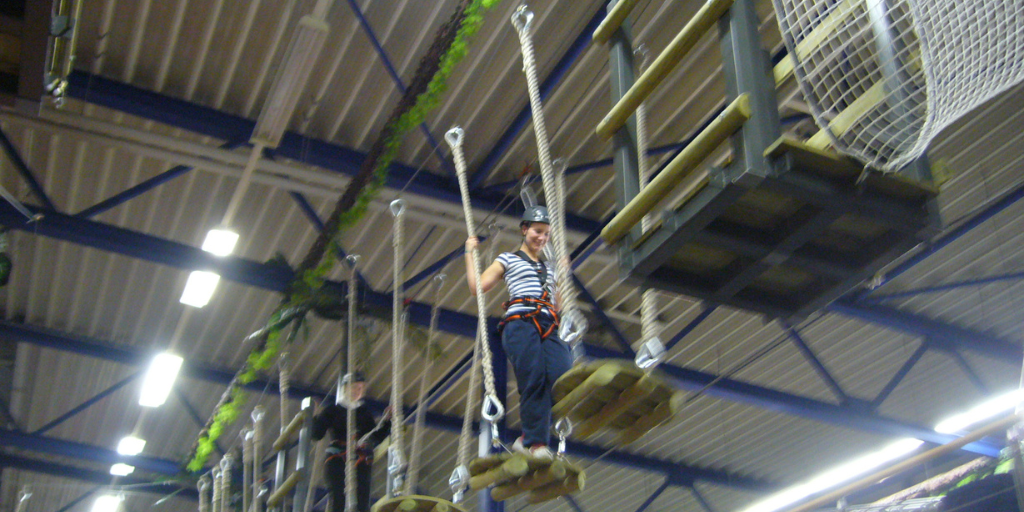
Executing a highly profitable indoor ropes course construction requires a delicate balance between structural engineering and innovative spatial design. By utilizing ceiling suspended networks, operators can transform empty overhead volume into a high-capacity revenue generator without sacrificing ground-level arcade or dining space. This architectural pivot enables Family Entertainment Centers to offer weather-proof thrills that dramatically increase overall visitor dwell time.
Why family entertainment centers are pivoting to aerial attractions
Modern recreational facilities must constantly evolve to keep guests engaged and maximize their real estate footprint.
Maximizing spatial design in FEC aerial attractions
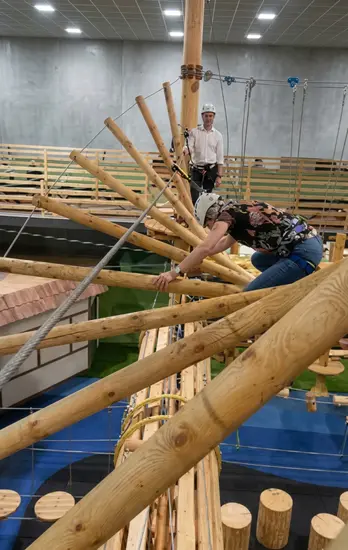
Integrating a ceiling suspended ropes course allows operators to monetize the unused vertical space above existing attractions like bowling alleys or seating areas. This dual-use spatial design significantly boosts the revenue per square meter while creating a visually striking anchor attraction that draws spectators. Adopting these elevated challenges helps facilities capture older demographics and highly profitable corporate team-building groups.
- Increased total throughput by layering attractions vertically.
- Higher visual engagement that drives organic social media marketing.
- Diversified audience appeal beyond standard ground-level arcade games.
Ceiling loads and structural rigging requirements
Unlike outdoor forest parks, ensuring the structural integrity of the host building is the most critical phase of any indoor installation.
Calculating dead and live loads for indoor adventures
The primary challenge in indoor ropes course construction is safely managing the dead and live loads imposed on the building's existing roof framework. Engineers must perform detailed load capacity assessments to determine if the current beams can support the dynamic forces of moving participants and heavy safety gear. When existing structures fall short, custom structural steel rigging is fabricated to securely distribute the kinetic weight across primary building columns.
- Dynamic load modeling prevents structural fatigue from participant movement.
- Custom structural steel rigging fortifies weaker retail ceiling grids.
- Redundant safety cabling ensures compliance with strict safety standards.

Multi-directional layouts for small footprints
Designing an engaging course within tight indoor confines demands a highly efficient and creative routing strategy.
Ceiling suspended ropes course layouts
A well-planned multi-directional layout maximizes the number of obstacles and platforms without making the environment feel cramped or chaotic. By using overlapping paths and shared central access towers, operators can fit longer, more complex challenges—or even an indoor zipline design—into a remarkably small cubic volume. This strategic routing prevents bottlenecks during peak hours, ensuring a smooth and highly profitable visitor flow rate.
- Overlapping obstacle paths create a denser, more exciting visual environment.
- Shared access platforms reduce the total structural materials needed.
- Optimized participant flow prevents traffic jams during busy operational weekends.
HVAC, lighting, and theming integration
Successfully building an aerial park indoors requires careful coordination with the building's essential utility systems.
Engineering indoor ropes courses for retail malls
During indoor ropes course construction, designers must meticulously route cables and platforms around existing HVAC ducts and fire suppression systems. Proper integration of ambient and theatrical lighting is crucial, as the suspended structures can cast large shadows over the ground-level attractions below. Integrating immersive theming directly into the support poles and platforms masks the industrial rigging, delivering a cohesive and premium guest experience.
- Strategic obstacle placement avoids obstructing crucial fire sprinklers.
- Integrated LED lighting illuminates the course while preventing ground-level shadows.
- Thematic cladding hides bare steel rigging for a polished aesthetic.
Mastering the complexities of indoor ropes course construction empowers operators to unlock massive revenue potential hidden right above their guests' heads. By rigorously managing ceiling load capacity and implementing proactive lifecycle management, facilities can safely deliver high-impact thrills in compact environments. Investing in this vertical real estate ensures your entertainment center remains a dynamic, highly profitable destination for years to come.
Planning an Adventure project? Need expert advice on Adventure park design?
Get in touch today!
Frequent asked questions
How do you calculate ceiling load capacity for an indoor ropes course?
Structural engineers analyze both the dead load of the equipment and the live load of active participants swinging on the elements. This rigorous mathematical assessment determines if your indoor ropes course construction requires supplemental steel reinforcement to handle the dynamic stress safely.
What are the space requirements for a multi-directional layout?
A robust multi-directional layout can be installed in surprisingly compact areas, often requiring as little as a few hundred square meters of ceiling space. The key is utilizing overlapping obstacle routes and centralized access points to maximize the physical footprint.
How does an indoor ropes course impact existing HVAC systems?
Professional indoor ropes course construction requires mapping the attraction completely around existing ductwork and airflow paths. Designers ensure that platforms and cables never block fire sprinklers or ventilation systems, maintaining full building code compliance.
Can you build a ceiling suspended ropes course in an older mall?
Yes, older retail structures can host these attractions by retrofitting the building with custom structural steel rigging. This supplementary framework independently supports the ceiling suspended ropes course without over-stressing the mall's original, aging roof trusses.
What is the ROI for FEC aerial attractions?
Facilities often see a rapid return on investment because these attractions utilize zero ground-level square footage, instantly adding a completely new revenue stream. To ensure staff are ready to handle this capacity safely, proper training and education is essential for smooth daily operations.
Additional expert information on the Adventure Business
Interested to read more about the Adventure Business with our expert articles?
- Logistics and throughput in Adventure Parks, key elements in Customer satisfaction
- Integrating Gaming Technology into Adventure Parks
- How to plan your Adventure Park spatial requirements for maximum ROI
- Adventure Park Installation: How to Ensure Your Attraction is Built Right, the First Time
- Design is Your Best Investment Adventure Park Design
- The Benefits of Integrating Urban Adventure Play in Commercial Retail
- Creating Profitable Adventure Parks: Tips and Strategies
- Roller Coaster Zipline: The Thrilling and Profitable Amusement Solution
- Operational efficiency versus asset addiction in high-volume venues
- The Net Maze Attraction: Safe, Scalable Active Play for All Ages
- How to Launch a Zip Line Company
- Ride a bike modified to attach to a zipline cable
- Rope Course Construction: A Comprehensive Guide
- Leisure and Adventure in Retail Real Estate: The Future of Shopping
- The Benefits of Netted Attractions for Operators and Guests