


• 1.jpg
  • 2.jpg
  • 3.jpg
  • 4.jpg
  • 5.jpg
  • 6.jpg
  • 7.jpg
  • 042A8449-LowRes.jpg
  • inclusive-climbing.jpg
  • JULY-24-071.jpg
  • JULY-24-079.jpg
  • RVR_zipline-06.jpg
Improve your adventure park capacity with expert tips on harnessing, briefing, and layout design. Maximize your ropes course throughput to increase profits today.
◆ Adventure Business · Guide

Maximizing ropes course throughput

Maximizing ropes course throughput is the single most effective way to turn your aerial adventure park into a highly profitable operation. When operators streamline guest flow, they instantly increase daily capacity without compromising the visitor experience. Smart design choices and efficient operational procedures are the foundation of a high-functioning facility.

TL;DR

Key takeaways

Higher daily revenue is achieved by optimizing time slots and active element management.
Lower staffing costs directly result from improving your overall operator-to-guest ratio.
Improved guest experience occurs naturally by proactively reducing frustrating bottlenecks and wait times.
Course Layout

Linear vs. multi-directional layouts

A traditional linear belay line forces every guest to follow the exact same path from start to finish. If one participant freezes on a difficult obstacle, the entire line halts and your throughput plummets. Operators must carefully evaluate their target audience before committing to a rigid, single-path design.
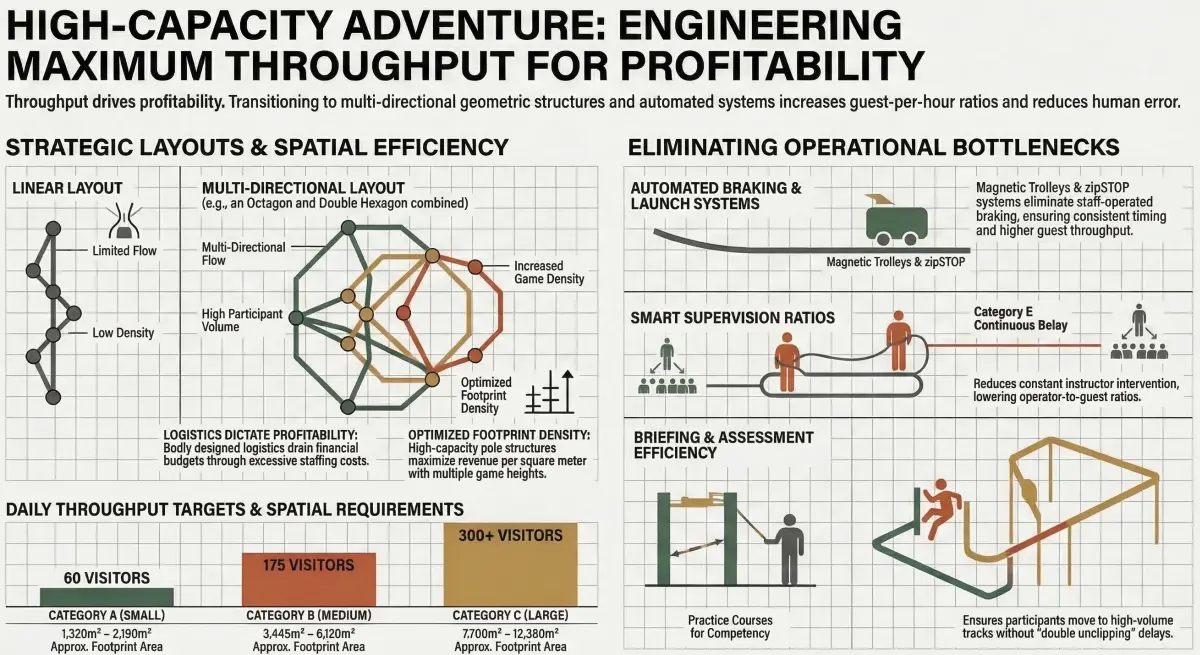
Multi-directional ropes course layout design improving guest throughput

Multi-directional hub designs disperse crowds to reduce waiting.

Implementing a multi-directional layout utilizes a hub-and-spoke design to disperse crowds efficiently. This allows faster climbers to bypass slower participants by choosing alternative routes from central platforms. Distributing traffic across multiple challenge levels prevents jams and maintains a steady guest flow management system.

Explore high-capacity ropes course designs

Guest Flow

Eliminating bottlenecks on the course

Identifying and resolving congestion points is critical for maintaining a profitable pace. The most common bottleneck occurs at zip line departures or highly technical physical elements. When participants hesitate, the ripple effect delays the entire session and damages your operator-to-guest ratio.

Key bottleneck solutions

  • Provide bypass options alongside highly technical obstacles to keep traffic moving.
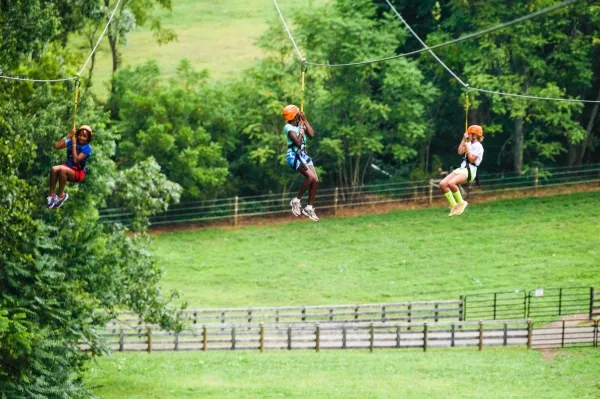
  • Install automated braking on zip lines to radically speed up landing clear times.
  • Limit element length to ensure faster crossing times from platform to platform.
Operational Efficiency

The impact of briefing and harnessing speeds

Your operational efficiency on the ground directly influences your capacity up in the trees. Efficient harness rack management ensures that groups transition smoothly from the ticket counter to the training area. If your instructors spend excessive time untangling gear, your overall ropes course throughput suffers before guests even leave the ground. Pre-sizing harnesses and staging them in dedicated zones dramatically accelerates the gearing-up process.

Streamlining the safety briefing is just as vital for boosting your adventure park capacity. Utilizing a continuous belay system reduces the complexity of ground school, allowing instructors to deliver concise instructions. Faster ground processing means more active climbing time for guests and higher daily rotations for your business.

By embracing multi-directional layouts and eliminating physical bottlenecks, you ensure a fluid and enjoyable experience. Optimizing these critical workflows allows your adventure park to safely operate at its true financial potential.
Common Questions

Frequently asked questions

What is a good throughput for a ropes course?

A highly optimized ropes course throughput can process anywhere from 100 to over 300 guests per hour depending on the footprint. Facilities utilizing a multi-directional layout typically see the highest volume. Evaluating your specific infrastructure is necessary to set realistic baseline goals.

How do you calculate adventure park capacity?

You determine your adventure park capacity by multiplying the number of active elements by the average time it takes a guest to cross them. You must also factor in your operator-to-guest ratio and safety briefing durations. Tracking these metrics during peak hours provides an accurate baseline for daily volume.

Which ropes course layout is best for high volume?

A hub-and-spoke or multi-directional layout is the most effective design for processing large crowds. This structure allows guests to choose their own paths and easily bypass slower climbers. Avoiding a strict linear belay line is the best way to prevent frustrating traffic jams.

How can operators speed up harnessing?

Implementing strict harness rack management prevents tangled gear and confused guests. Pre-adjusting equipment before peak hours allows instructors to quickly equip visitors and move them to ground school. This ground-level efficiency directly improves your overall throughput.

What causes bottlenecks on an aerial adventure course?

The most frequent bottleneck is caused by highly technical elements or long zip lines that induce participant hesitation. When climbers freeze, the flow of traffic completely stops, drastically lowering your guests per hour. Providing alternative easier routes around these elements keeps the progression steady.

EN 15567 Compliant High-Volume Design Flow Management Optimization

Ready to maximize your park's capacity?

Contact our team to discuss multi-directional layouts, automated systems, and operational solutions that unlock higher daily revenue.

Related reading

Explore the adventure business

Turnkey planning Build Your Park

The full Skywalker process: from fixed-price feasibility study through design, engineering and opening day.

Service Consultancy — Feasibility & Concept

What a Skywalker feasibility study covers — and how the fee credits back into construction cost.

Service Design & Architecture

How Skywalker translates a site concept into engineered construction drawings and permit-ready specifications.

Service Concepting & Theming

Turning a site brief and investor vision into a coherent, themed guest experience with commercial logic.

Service HRM & Operations Planning

Staffing structures, hiring frameworks and operating model design for adventure parks at scale.

Product AirCruizer Cable Bicycle

An aerial cable bicycle that adds a low-intensity, family-accessible revenue stream to any adventure destination.

Product Net Adventure

Multi-level suspended net structures — high dwell time, low staffing cost, strong ROI for family parks.

Product Ultimate Adventure Tower

A vertical multi-discipline anchor attraction that drives park-wide footfall and upsell across adjacent attractions.

Service Zipline Design & Engineering

Engineered zipline specifications — why site-specific design protects your permit, insurance and long-term operating margin.

Products overview All Products — Attraction Range

Browse the full Skywalker product range to plan your park's attraction mix and revenue model.