






• 1.jpg
  • 2.jpg
  • 3.jpg
  • 4.jpg
  • 5.jpg
  • 6.jpg
  • 7.jpg
  • 042A8449-LowRes.jpg
  • inclusive-climbing.jpg
  • JULY-24-071.jpg
  • JULY-24-079.jpg
  • RVR_zipline-06.jpg
◆ Zipline design · Guide

Zipline cable tension and sag: how to calculate them

Cable tension decides the size of your cable, towers and anchors. It depends mostly on one design choice: how much the cable sags. This guide explains the relationship, gives the formula and lets you run an indicative check for your own line.

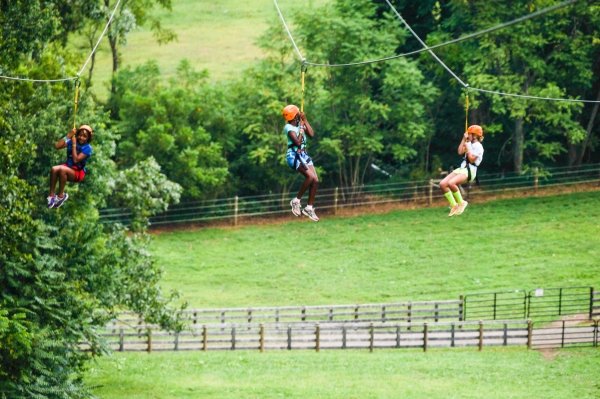
Zipline cable running between two towers across a valley
Short answerTension rises as sag falls. With a rider at mid-span, the horizontal cable tension is roughly H = (P·L/4 + w·L²/8) / d, where P is the rider load, w the cable weight per metre, L the span and d the sag. Halve the sag and the tension doubles. Lines are usually designed with a sag of around 4–8 % of the span.
Cable tensionSagAnchor loadsCalculator
The physics

Why tension goes up when sag goes down

A cable can only carry load by hanging in a curve. The flatter the curve, the harder the cable has to pull to hold the same weight. That is why a tight, flat zipline puts very high forces on its anchors.

The formula

H = (P · L / 4 + w · L² / 8) / d
Vtop = P / 2 + w · L / 2 + H · h / L
Tmax = √(H² + Vtop²)
  • P: rider plus trolley weight (kN)
  • w: cable weight per metre (kN/m)
  • L: horizontal span (m)
  • h: height difference between the anchors (m)
  • d: sag at mid-span with the rider on the line (m)
  • Tmax: tension at the upper anchor, the highest point load

Example: 300 m span, 25 m drop

Rider 100 kg plus 2 kg trolley, cable weight 1.0 kg/m. Rider at mid-span.

SagSag depthHorizontal tensionMax tension
2 %6.0 m (20 ft)30.9 kN31.2 kN (7.0 kip)
3 %9.0 m (30 ft)20.6 kN20.9 kN (4.7 kip)
4 %12.0 m (39 ft)15.5 kN15.8 kN (3.6 kip)
5 %15.0 m (49 ft)12.4 kN12.7 kN (2.9 kip)
6 %18.0 m (59 ft)10.3 kN10.7 kN (2.4 kip)
8 %24.0 m (79 ft)7.7 kN8.2 kN (1.8 kip)
10 %30.0 m (98 ft)6.2 kN6.7 kN (1.5 kip)

Going from 8 % to 4 % sag roughly doubles the tension, from about 8 to 16 kN (1.8 to 3.6 kip).

A simplified modelThe formula treats the rider as a point load at mid-span and ignores cable stretch. It is good for a first check and for comparing options. A design calculation uses the elastic catenary, the rider in every position and the real cable data.
Indicative check

Check the tension on your line

Enter your span, drop, sag and loads. The tool shows the sag depth, the cable tension and the breaking force you would need at a safety factor of 3 (you can change the factor).

DisclaimerThis calculator is for general information only. It gives a rough, indicative figure from a simplified model and is not an engineering calculation, design or advice. Do not use the results to select a cable, build or modify a zipline, or to judge whether an existing line is safe. Skywalker Adventure Builders accepts no liability for any loss, damage or injury arising from the use of this calculator or its results. Every zipline must be designed, calculated and inspected by qualified professionals.

Cable tension is only a small part of zipline engineering

The number above covers one load case on one component. A real zipline design also includes:

  • The rider in every position along the line, not only at mid-span
  • Braking and impact loads at the arrival end
  • Wind, ice and temperature through the seasons
  • Cable stretch and the elastic catenary
  • Cable type, terminations and their capacities
  • Towers, anchors and foundations
  • Speed, arrival speed and the landing zone
  • Ground clearance, rescue and inspection

That is why the calculator does not replace an engineered design. Our Zipline Feasibility Study and engineering cover all of it for your site.

Design choices

Choosing the sag for your zipline

Too little sag (below about 4 %)

  • Much higher cable and anchor tension
  • A deeper dip near the end of the line
  • Lighter riders in a high-drag position may stop short, especially with a headwind

Too much sag (above about 8 %)

  • Every rider arrives, but the ride is slower
  • Taller towers to keep ground clearance
  • Lower loads on cable, towers and anchors

What the simple formula leaves out

✓
Braking and impact. The end brake adds load; see zipline braking dynamics.
✓
Wind, ice and temperature. They change sag and tension through the season.
✓
Cable stretch. The elastic catenary gives a different loaded sag than the unloaded profile.
✓
Anchors and towers. They must carry the full tension in the right direction; see the landing zone guide for the arrival end.

Our zipline design & engineering team runs the full calculation for your line.

Frequently asked questions

How do you calculate zipline cable tension?

With the rider at mid-span, the horizontal tension is about H = (P·L/4 + w·L²/8) / d. The maximum tension at the upper anchor adds the vertical forces: T = √(H² + V²). A design calculation goes further and uses the elastic catenary.

What sag should a zipline have?

Lines are often designed with a sag of around 4–8 % of the span. Less sag means more speed but much higher tension; more sag means lower loads but a slower ride and taller towers.

Why does a tighter zipline have more tension?

A cable carries load by hanging in a curve. The flatter the curve, the harder it has to pull to hold the same weight. Halving the sag roughly doubles the tension.

What safety factor does the calculator use?

The calculator checks the cable's minimum breaking force against a factor of 3 by default. You can change it. The factor for a real line is set in its engineering, together with all other load cases.

Read more
Zipline design packages
From a 5–10 day feasibility study to the Construction Book and certification support. Fixed fee per package, the study fee credited back when we build.
✓ Adventure park builder since 2005✓ Ziplines designed to EN 15567✓ Annual main inspection and lifecycle support✓ Offices in Ede, Amsterdam, Dubai and Riyadh

Need the real numbers for your line?

Our Zipline Feasibility Study calculates speed, sag, tension and anchor loads for your site, as a fixed-fee assignment quoted in writing first.