

Why belay selection is an operational decision, not just a safety requirement
Self-belay, Smart Belay, and Continuous Belay compared
Use this matrix to assess which system best fits your operational profile. Skywalker recommends Smart Belay or Continuous Belay for all new installations; self-belay is included for reference against existing infrastructure only.
| Criteria | Self-belay | Smart Belay | Continuous Belay |
|---|---|---|---|
| Overall safety level | Low | High | Optimal |
| Guest handling ease | Difficult | Improved | Superior |
| Staff efficiency (ROI impact) | Low | Moderate | High |
| Instruction complexity | Complex | Simple | Minimal |
| Visitor throughput | Low | Medium | Maximum |
| Retrofit compatibility | High | High | Low |
| Initial CAPEX | Low | Medium | High |
| OPEX / maintenance load | Moderate | High | Low |
| Skywalker recommendation | Not recommended | Recommended | Highly recommended |
Four systems for every ropes course configuration
Skywalker supplies two Smart Belay and two Continuous Belay systems, covering the full spectrum of ropes course throughput and installation requirements. All products are available to order directly from the shop, with installation documentation and EN 15567 certification support provided.
Protect your belay investment with the right service support
A belay system purchase is not a one-time transaction. EN 15567 requires periodic inspection cycles, and the long-term performance of any belay system depends on correctly trained operators and a structured maintenance programme. Skywalker offers two dedicated service paths alongside every belay system order.

What we build
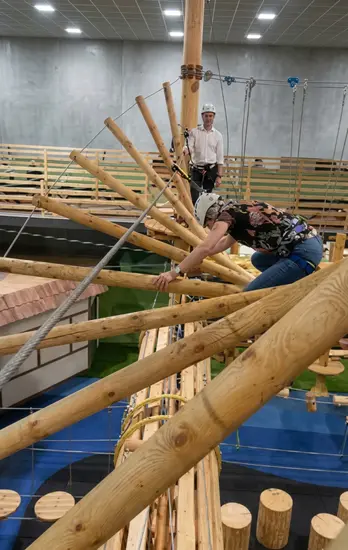
A commercial-grade adventure destination inside your existing building
"Only the roof is the limit — our indoor solutions are engineered around your space, not the other way around."
Design and engineering
Six features that drive throughput and repeat visits
Venue applications
Designed for every type of indoor commercial venue
The business case
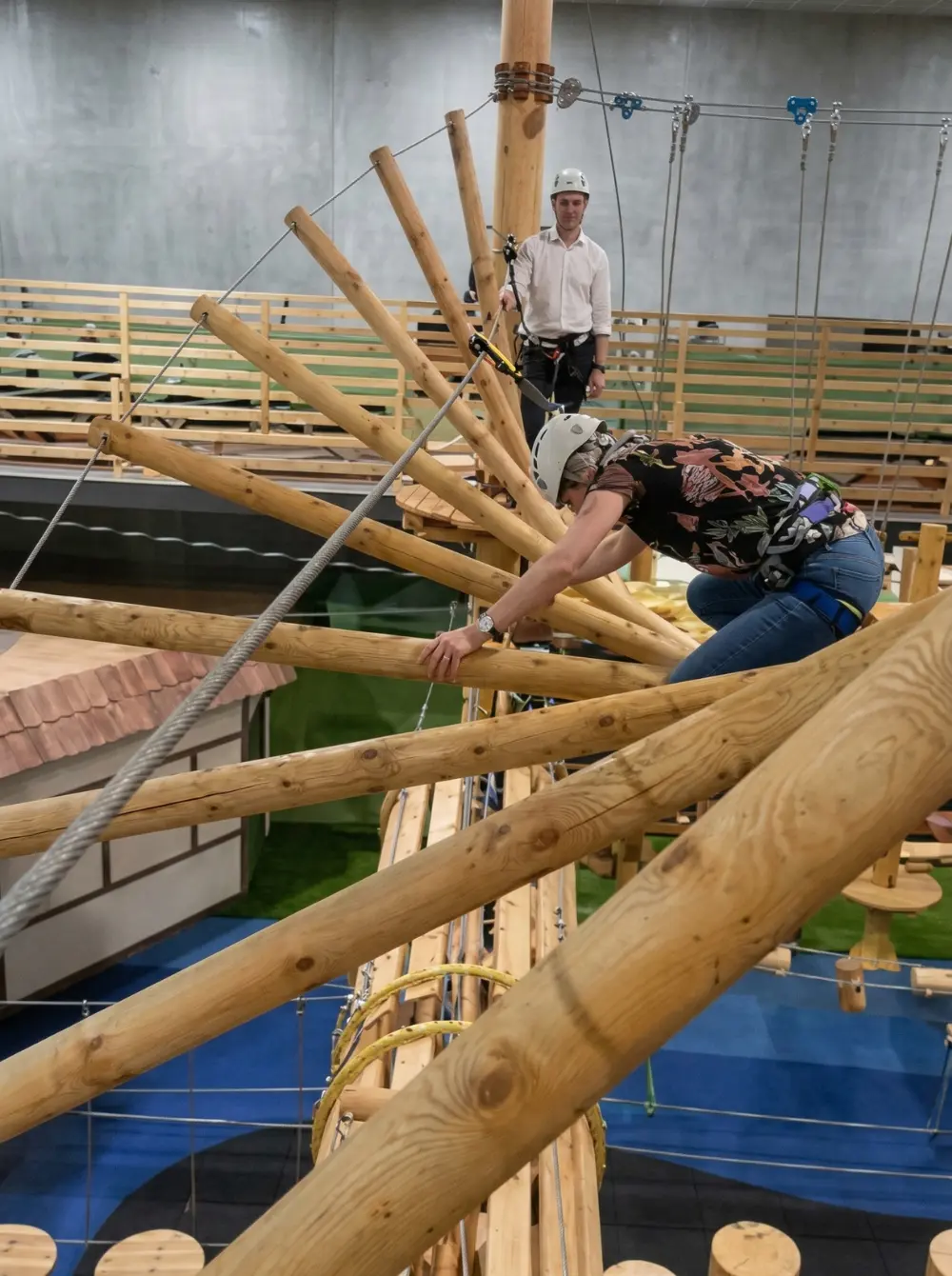
What an indoor ropes course does for your commercial operation
Frequently asked questions
Common questions about indoor ropes course projects
Planning your high ropes course project

Engineering commercial success, not just structures
From first site visit to a fixed-price commitment
Site assessment & feasibility study
After signing an M-NDA, our engineers assess terrain profiles, environmental constraints, access routes, and visitor flow potential. Output: a conceptual 3D render and preliminary throughput model. The feasibility fee is 100% credited back to the final construction contract.
Concept design & 3D modelling
The design team translates feasibility findings into a full concept: layout, element mix, pole or tree anchoring approach, and a themed visual identity aligned with your brand and target audience. All concept and sketch phases require client input and approval before progression.
Structural engineering & technical dossier
Full structural force analyses, cable tension calculations, anchor load ratings, and wind-load modelling are completed using proprietary simulation tools. All calculations comply with EN 15567 (European Ropes Course Standard) as a contractual minimum. The Technical Dossier produced here is required for regulatory approvals.
Permits, compliance & fixed-price contract
Early coordination with TÜV or equivalent inspection bodies and ERCA guarantees compliance before construction begins. The Technical Dossier supports all permit applications. A binding, itemized fixed-price contract is issued with zero hidden costs. Permits and country-specific approvals can be included as part of our services.
Precision delivery and long-term asset protection
Precision installation & construction
Skywalker's certified construction teams execute the engineering blueprints with no permitted deviation from design. Proprietary, eco-friendly anchor systems protect tree integrity where applicable. Freestanding pole configurations offer higher game density and a predictable maintenance budget. Typical construction period: 6 to 8 weeks from site mobilisation.
Commissioning, certification & staff training
A final Site Acceptance Test (SAT) is conducted by an independent inspection body — TÜV or an equivalent national authority. ERCA-standard staff training is delivered on-site covering harness protocols, inspection cycles, and emergency procedures. Complete technical dossiers and maintenance manuals are handed over at opening.
Ongoing lifecycle management
Bimonthly operational checks and mandatory annual inspections by Type C inspectors (EN ISO/IEC 17020) keep your facility at peak performance. Flexible maintenance contracts and HRM staffing solutions are tailored to your operational season. The commercial relationship extends far beyond handover.