

The eight technical pillars of high-performance zipline design
Commercial zipline success depends on rigorous data analysis and risk mitigation at every stage. Our engineering team focuses on the critical markers that define attractions built to perform reliably at scale — season after season.
From first GPS coordinates to certified commissioning
Professional zipline design follows a structured, seven-stage path. Each stage builds on the last — reducing risk, controlling costs, and ensuring that the engineering package your contractor receives is construction-ready and fully certified before ground is broken.
Site evaluation
Topography, vegetation, natural features, access conditions, and prevailing wind patterns are assessed against your concept. All that is needed to begin is a pair of GPS coordinates for your proposed start and end points — a topographical survey with elevation data accelerates this stage further.
Feasibility study and simulation
Advanced simulation software builds a virtual model of your zipline and tests it from every angle. The output covers zipline profile analysis, speed and trajectory simulation across the full weight spectrum, initial cable sag and tension estimates, and a go / no-go recommendation. Typical turnaround is five to ten working days.
Structural calculations and component specification
Structural engineers use the feasibility data as their direct input — producing certified analysis of trajectory, tower and anchor loads, braking forces, and all applicable safety factors. A complete component specification list is created: exact cable diameter, trolley models, harnesses, and braking system components are all defined by engineering, not assumption.
Course design and safety integration
Span length, tower placement, height variation, skill-level routing, and natural terrain features are resolved into a complete course design. Safety features — anchoring systems, effective braking and deceleration systems, and staff operational protocols — are engineered into the layout, not retrofitted after the fact.
Installation to industry standard
The zipline course, all safety features, and ancillary infrastructure are installed in strict accordance with the engineering package. Installation follows the blueprints for launch and landing towers, anchor systems, and cable rigging — with no deviations without sign-off from the engineering team.
Testing and inspection
The completed course is tested and inspected against the design specifications to confirm correct function, accurate braking performance, and compliance with the applicable safety standards before any guests are permitted to ride.
Maintenance and ongoing support
Regular inspections, prompt repair response, and equipment updates form the operational backbone of a safe and profitable zipline business. Our lifecycle management service provides a structured framework for this ongoing commitment, keeping your attraction performing to its design specification year after year.
The zipline feasibility study: data before capital
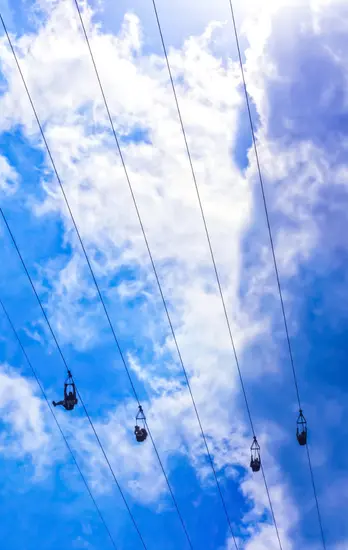
How simulation software transforms the design process
Advanced zip line simulation software is the engine behind our feasibility and engineering process. It shifts problem-solving from the construction site — where every change is expensive — to the digital model, where adjustments are fast, iterative, and free. The result is a design that has been stress-tested across dozens of variables before any physical work begins.
Why operators and investors choose Skywalker Engineering
Zipline engineering: frequently asked questions

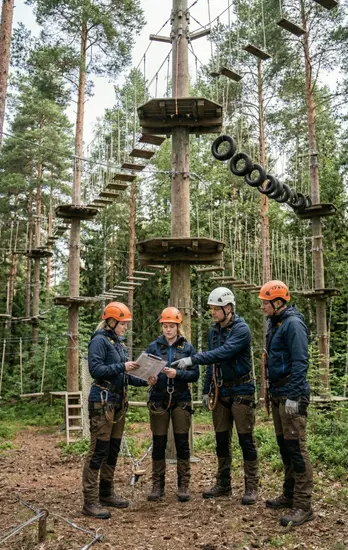
Six pillars of continuous park protection
Our programme covers every dimension of a park's operational health — from structural hardware to tree biology. Inspection and maintenance are treated as one integrated process, not separate contracts delivered by separate teams.
A structured schedule around your operating calendar
Our inspection cycle detects deterioration at the earliest stage — preventing closures and extending component life. Each level builds on the last, providing layered assurance across the entire operating year.
Bimonthly operational inspection
A trained Skywalker inspector conducts a full walkthrough of all active elements: cable condition and tension, hardware wear, belay system function, platform stability, and participant safety interfaces. Minor faults — connector replacements, rope swaps, clamp adjustments — are addressed on the same visit, eliminating the delay between identification and correction that external-only inspection contracts create.
Comprehensive structural inspection
A Type C inspector — certified under EN ISO/IEC 17020 (Inspection Body Accreditation Standard) — performs a deep structural review covering platforms, poles, foundation elements, embedded hardware, and biological support trees. This inspection generates a written report with findings, risk classification, and remedial recommendations. PPE certification — harnesses, helmets, and connectors — is completed simultaneously to fulfil the annual requirement under EN 15567 and European PPE Regulations.
Site Acceptance Testing (SAT)
Before any new attraction opens to the public, EN 15567:2015 mandates an inaugural inspection by an independent Type A body under ISO/IEC 17020. This impartial audit verifies that the facility meets all European safety and quality benchmarks before a single guest passes through. Skywalker facilitates this process through our established partnership with TÜV — one of Europe's most recognised certification organisations — coordinating the audit, documentation, and operational clearance to protect your opening timeline.
Full compliance with European certification requirements
Your builder is also your best maintenance partner
Most inspection providers work from drawings and site plans. Skywalker inspects from first-hand construction knowledge — every anchor point, cable diameter, and load calculation originated in our engineering office. This translates directly into faster inspections, more accurate risk assessment, and lower long-term maintenance cost.
Related services

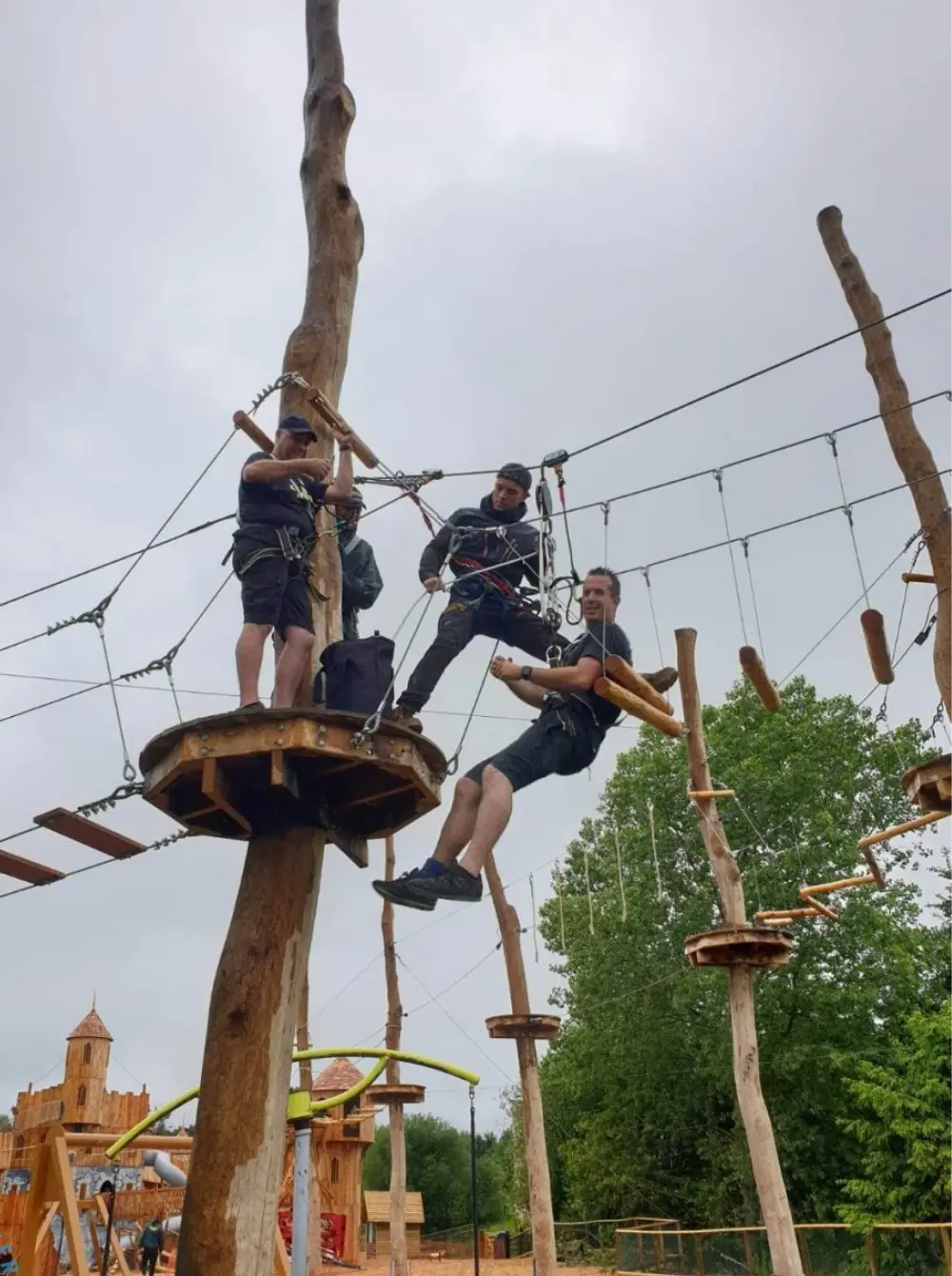
Your instructors are the primary risk control for every session
High-quality belay systems and structural engineering address the hardware risk. Trained, confident instructors manage everything else — guest behaviour at height, high-volume group supervision, and rapid-response rescue when an incident occurs. No automated system replaces that human layer.
Operators who underinvest in staff training consistently encounter the same problems: insurance complications, elevated incident rates, and guest experiences that do not convert to repeat visits. Operators who invest in structured qualification programmes outperform on safety metrics, review scores, and staff retention.
Seven ERCA-aligned qualification levels — theory combined with field practice
Each level in the Skywalker Training & Education syllabus combines classroom instruction with supervised field hours. Courses are matched to operational roles — from front-line instructors managing high-throughput guest flow to senior personnel conducting formal EN 15567 compliance audits. Completion requires both a written assessment and demonstrated practical competency.
Adventure Park Instructor
Designed for high-throughput commercial park environments. Covers group management, continuous belay supervision, peak-hour protocols, guest communication at height, and standard operating procedures for automated safety hardware.
Traditional High Ropes Course Instructor
Focuses on classic group development facilitation — corporate team-building, educational programmes, and individually belayed activity management. Emphasis on structured progression and participant confidence-building.
Generic Rescuer Course
Core technical rescue skills applicable across all aerial environments — lowering procedures, haul systems, communication under stress, and first-response protocols. An essential baseline qualification for all operational staff.
Traditional Ropes Course Facilitator
Specialised training for facilitators delivering developmental and therapeutic programmes. Focuses on group dynamics, structured debrief methodology, and adaptive facilitation techniques for diverse participant groups.
Site-Specific Instructor
Training customised to your exact course layout, hardware configuration, and operational procedures. Staff are certified on the specific elements and belay systems they will supervise every operating day — not a generic approximation.
Site-Specific Rescuer
Rescue protocols developed and rehearsed on your actual course configuration. Rescuers practise evacuation routes, anchor points, and lowering procedures that are unique to your installation — building muscle memory for real emergency scenarios.
Inspector Ropes Courses
Advanced qualification for in-house safety auditors and senior management. Covers EN 15567-01 inspection methodology, defect classification, documentation standards, and the dual-control principle required for credible self-assessment alongside third-party periodic inspections.
Training mandated by EN 15567-02 and aligned with ERCA guidelines
Enquire about certification →Training built by the engineers who built the course
Most training providers teach generic skills on generic equipment. Skywalker's programmes are delivered by the same technical team that designed and constructed your installation — which means your instructors learn on the actual hardware they will supervise, not a simulation of it.